If you've been following the Denver real estate market lately, you've probably noticed that the headlines are all over the place. Prices are up! Sales are down! Buyers have leverage! Sellers are holding steady! Interest rates are doing whatever interest rates feel like doing that particular Tuesday.
Confused? Excellent. Welcome to real estate in 2026. Here's what I think is getting lost in all the noise. We're spending SO much time talking about home prices that we're missing what's actually happening behind the scenes. Because right now, the number a house sells for and the deal that actually gets negotiated can be two very different things.
And honestly, that's where things get interesting.
Let's Talk Numbers. The Ones That Actually Matter.
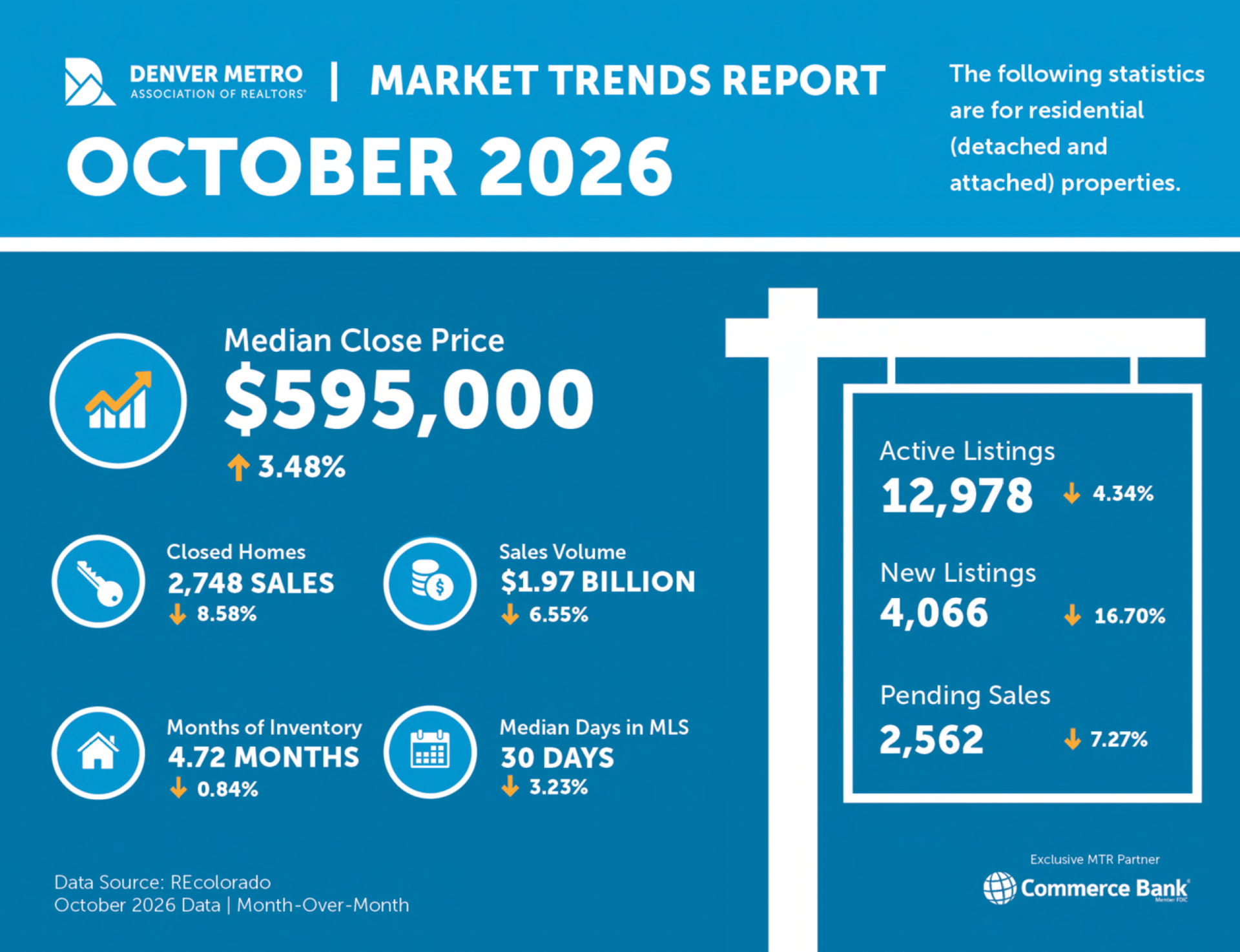
According to the latest Denver Metro Association of Realtors (DMAR) report, October ended with 12,978 active listings across the Denver metro, down 4.34% from September, yet still 3.87% higher than this time last year. We closed 2,748 homes, which represents a 23.54% drop compared with October 2025. That's a pretty significant slowdown in the number of people actually moving.
And yet, the average closed sale price came in at $715,560, UP 2.22% from September. Homes spent an average of 50 days in the MLS, and we're sitting at 4.72 months of inventory. So we've got fewer transactions, a healthy amount of inventory and average prices that actually increased month over month. If you're wondering how all of those things can be true at once, you're asking exactly the right question.
Because averages tell us what happened across thousands of homes. They don't necessarily tell us what happened within each individual transaction, and that's an important distinction.
The Part You Don't See on Zillow
Here's the number that really caught my attention this month.
According to DMAR, 65% of homes that sold in October involved a seller concession, with an average concession of $12,557. SIXTY-FIVE PERCENT.
That's a lot of negotiations happening behind the scenes, and it's a perfect example of why looking at the final sale price doesn't always give you the complete picture. Let's say a house sells for $700,000, and the seller agrees to contribute $15,000 toward the buyer's allowable closing costs or an interest-rate buydown. The recorded sale price is still $700,000, even though the seller is contributing additional money to make the transaction work.
Now, that doesn't mean every seller concession is automatically a price reduction in disguise. Sometimes the structure of the deal is actually more beneficial to the buyer than simply negotiating a lower price. Other times, the seller's net proceeds are the deciding factor. The important thing is understanding the entire transaction instead of focusing solely on that big number at the top of the contract. And that, my friends, is why I get a little twitchy when someone tells me their neighbor sold for a certain amount and assumes that must be exactly what the seller walked away with. There is often a LOT more to the story.
Buyers, This Is Where Your Opportunity Lives
If you're buying right now, I want you to understand something. Negotiating doesn't always mean getting the seller to slash $50,000 off the asking price. Sometimes it means asking for money toward closing costs. Sometimes it's negotiating an interest-rate buydown, addressing inspection concerns or finding terms that make the overall purchase more manageable. And sometimes, it's a combination of several things.
The trick is understanding which option actually benefits your situation. A $10,000 price reduction and a $10,000 seller credit are not necessarily going to have the same impact on your monthly payment or the amount of cash you need at closing. Financing rules matter, and your lender should help run those scenarios before you decide which direction makes the most sense. I've had some incredibly complicated transactions recently where the solution wasn't simply lowering the price. It was getting everyone around the table, understanding the numbers and finding a structure that worked for both sides.
And THAT is the kind of problem-solving I love about this business.
Sellers, Please Don't Confuse Your Asking Price With Your Bottom Line.
On the flip side, sellers need to be thinking about the entire financial picture, too.
If your home is listed at $750,000 and a buyer offers $740,000 with no concessions, that's a very different conversation from an offer at $750,000 with $20,000 in seller-paid costs. The terms, financing, appraisal considerations, inspection obligations and likelihood of closing all play a role in determining which offer is actually stronger.
This is also why pricing your home correctly from the beginning matters. Buyers have choices, and they're paying attention. October's average marketing time was 50 days, which means sellers need to be prepared for a process that may take longer than the days when a house could practically sell before the sign went in the yard. The best strategy isn't always accepting the highest number or refusing to negotiate because you feel like you've already priced fairly. It's understanding your competition, knowing your priorities and making decisions that get you closer to your actual goal.
And sometimes that means getting a little creative.
So, Is Denver a Buyer's Market or a Seller's Market?
I know everyone wants one simple answer here, and I'm going to give you my favorite Realtor response.
It depends.
Sorry. I know.
With 4.72 months of inventory, we're sitting in what is generally considered a more balanced market. That gives buyers more opportunity to negotiate than they had during the frenzy a few years ago, while well-positioned sellers can still achieve strong outcomes. And not every corner of the market is behaving the same way. Detached homes sold for an average of $785,896 in October, while attached homes averaged $451,494. Condos and townhomes are also generally taking longer to sell, with an average of 69 days in the MLS compared with 45 for detached properties. What works for a single-family home in a highly desirable neighborhood may look completely different for a condo competing with several similar units.
This is why I spend so much time looking at the actual competition, not just the broad Denver numbers.
Here's What I Really Want You to Take Away.
I don't think the biggest opportunity in today's market is waiting for some magical moment when everything suddenly becomes affordable, predictable and easy.
It's understanding what's actually available to you RIGHT NOW. Maybe you're a buyer who could benefit from negotiating closing costs instead of focusing entirely on price. Maybe you're a seller who needs to think through the net proceeds of an offer instead of getting hung up on the headline number. Or maybe you're someone who wants to move and simply needs a better understanding of how the numbers could work. All of those conversations start in the same place: a plan.
I don't believe in convincing someone to buy or sell simply because the calendar says November or because a headline makes the market sound exciting. I believe in knowing the numbers, asking the right questions and exploring the options that make sense for your life. Because a good real estate transaction isn't necessarily the one with the biggest sale price or the biggest discount. It's the one where everyone understands the deal they've made, the numbers work and we can confidently get to the closing table. And in this market? That's a pretty fabulous outcome.
Curious what your home is actually worth, what you might net from a sale or what negotiating opportunities could look like on your next purchase? Reach out! I'd love to walk through the numbers with you